Showing posts with label Science Fiction. Show all posts

Wednesday, February 3, 2016

The Darkest Minds by Alexandra Bracken

In The Darkest Minds, the first installment of The Darkest Minds Trilogy, we are introduced to a world afflicted by the IAAN disease, short for Idiopathic Adolescent Acute Neurodegeneration.  Only affecting children in the early stages of puberty, this disease results in the death of nearly every child in America.  Those that manage to survivor find themselves with one of five strange psychokinetic powers: hyper-intelligence (labeled a Green), telekinesis (Blue), electrokinesis (Yellow), pyrokinesis (Red), and mind control (Orange).  Under the guise of rehabilitation, all children who managed to survive IAAN, now labeled as “psi,” are rounded up and placed into camps, where they are kept under strict control and prevented from using their abilities.  It’s on Ruby’s tenth birthday that she inadvertently uses her new found abilities as an Orange and is soon taken to one such camp.  She manages to remain undetected by masquerading as a Green for six years but is forced to flee with the help of an anti-governmental group, The Children’s League.  It isn’t long until she realizes they aren’t what they seem and is on the run again, managing to escape with a small group of renegade kids off in search of a safe haven for all those labeled as psi.  But is the sanctuary everything it seems, or is it merely a staging area for greater forces?


There’s no denying that this is an exciting YA trilogy.  In today’s market dystopian fiction and superpowers are an immensely popular combination that, if written well, are sure to find a thrilled audience.  Sadly, The Darkest Minds doesn’t really hold much under the surface.  There’s a story being told and the coming-of-age lessons that are trying to be told are clear, but the manner in which both are delivered leaves a lot to be desired.

Before delving into some of its problems, I want to say I don’t think that this is an awful book.  It’s well-written and, if you don’t think too much, the story is consistent within its own reality. Plus, some of the mutations/powers are fairly interesting.  I can also see the appeal to a reader audience who want either a) some story to encompass a romance and are just interested in the struggle of those involved with said romance or b) a coming-of-age story that, though fictitious, has qualities relatable to the real world.  In that regard, this story is better than a number of series on the market, thus far at least.

At the same time, this story does seem rather formulaic.  There is a clear-cut bad person/organization.  There is an opposing person/organization that seems good but, surprise, is actually just as bad.  There is another person/organization that is less powerful but is, ultimately, good.  Or is it?  [Insert ominously foreboding soundtrack here]  Then there is the main character who finds a small group of friends, all of whom just want to survive, free of the games of those who wish to use them as pawns or do them harm.  Ultimately, through a progression of events, the main character(s) grow and realize they can’t just run from the fight but must throw themselves into the fray for the greater good.

In any good story there will be complex characters who undergo some development – at least to some small degree in a story that’s part of a series. That being the case no character should be perfect, much less start out perfect.  That’s definitely not the case here, with a main character, Ruby, who is most definitely not perfect in a multitude of ways.  While there is some character growth, at the end of this trilogy’s first installment, Ruby has only grown into a likeable character.  This means that for the majority of the story, Ruby was altogether unbearable.  Given the scenario (which I’ll get into in a moment) Ruby acting the way she does is believable.  However, believable doesn’t mean good.  It’s one thing to write a character who is believable and another thing entirely to write a believable character that people are actually interested in reading about, following, and cheering on.

The scenario for this world is difficult to swallow.  Simply put, bad guys are bad because bad guys have to be bad.  There isn’t a lot of legitimate reasoning behind why the villains are acting like villains other than the story needs an antagonistic force for the reader to be aware of. The reasoning behind the main conflict, locking up all the children because they are powerful (which goes into the whole ‘fearing what you don’t understand’), only makes sense if you don’t actually think about it.  When all your country’s children are infected with something, locking them all up in prison camps without looking for a way to cure them seems like a good way to effectively set an expiration date on your country.  Plus, too much of the story is a road trip.  It’s interspersed by some moments of actions and exposition, but it’s too drawn out and makes it difficult to stay with the story without hoping for something else to happen already.

Now, maybe Ruby gets more complex and bearable in the following story.  Maybe the villains become more complex.  Maybe the reasoning becomes more apparent.  I have strong doubts about that last point, but the first two are possible.  However, there has to be a reason to want to read more and look for that explanation.  A good assessment of something should encompass the whole of its part but, while I am curious, there’s no incentive that’s provided to actually keep the reader going.  It’s out of sheer curiosity about why this series has the popularity it does that I’ll read the second novel, and nothing more.

As I said before, this story has merits when not examined too deeply, and I can see the appeal it might have to specific audiences (ones I personally don’t fall into).  While I might not recommend this story as heartily as other YA series, this isn’t a book that I’d outright dissuade someone from reading.  Fair warning though, don’t expect too much.

Rating: 2/5

Saturday, September 12, 2015

The Doors You Mark Are Your Own by Okla Elliott and Raul Clement

In this pseudo-translated historical text, originally written by an author from a time in our own alternate distant future, we learn of a world before that time yet occurring after the fall of our own (or possibly our recent past). As stated by the book’s own summary, this “blends elements of Nazi Germany, Soviet Russia, and Golden Age Hollywood.”  The main story itself is that of a world that had been nearly destroyed due to events not limited to, but largely centered on, the contamination of the world’s water, causing nekrosis in all those it infected.  However, various dying cultures managed to come together and settle around a clean water source and survive, though on a much smaller scale than they previously existed.  Now, that same contamination has reappeared and tensions are growing within and amongst the various cities.  In the greatest and most powerful of these cities, Joshua City, the leader uses this reemergence as an excuse to declare war on the others, starting with the herdspeople of Ulan-Ude, as the first step in gaining power of all seven cities.  However, this military campaign has led to civil unrest within Joshua City’s own borders.  The foremost of the points of view shown to us belong to that of Nikolas, Marcik, and Adrian.

As noted in the summary, this book is fictitious but still possesses a very real air about it.  Along with footnotes, there are moments within the false history/story—which is to say, not including the prologue(s)—when the nonexistent original author, Aleksander Tuvim, and the two real authors but self-described translators, Okla Elliott and Raul Clement, will pause the story and speak to the readers directly, elaborating on certain events in this history, providing both their own opinions and context on matters in such a way that it adds to the wonderful blurring of the line between historical retelling and fictitious story.

Though not a completely encompassing element of the The Doors You Mark Are Your Own, the book almost comes off as a ‘before’ story that so many popular series in entertainment lack.  This isn’t to say that the story isn’t outstandingly brilliant in its own right, but it is still an interesting element to consider.  In most stories, movies, or shows—most good ones, anyway—that begin with the key conflict already ongoing will have, at some point, a character briefly address the history of how and why the conflict came to be.  While that may address and clarify some key points, the audience is still left wondering about other details.  Given that this is the first installment of a lengthy trilogy, I’m interested to see whether the series will stay anchored in the current setting of Nikolas, Marcik, and Adrian’s timeline, as this book is itself just a ‘translation’ of Tuvim’s documentation of recent historical events, or if the story will precede to see change in his time, as the ‘translators’ of the book are well into the future of Aleksander Tuvim’s timeline.  Regardless, the book as a whole is marvelously crafted and has left me wondering just how the story will proceed. 

What is in a name?  At the end of the 8 page prologue—which is nothing when compared to the bulk of the book—a pivotal character (really, the pivotal character) in Tuvim’s modern day has a flashback.  While it means nothing at the time, it carries with it an implied weight.  At first the reader is only left to wonder at what it might mean, who are the people mentioned in it, what is so important about the name, what does ‘Messenger’ mean?  In fact, the prologue as a whole is well executed, giving bits of information to the reader, dropping names and events, keeping the reader curious throughout the book as they wait to actually see it unfold, see how the present came to be.  The prologue’s vagueness is perfect and it’s a promise of an exciting story to those who read on, a promise that it keeps.

Nikolas the Revolutionary.  A doktoral student turned revolutionary, and younger brother to Marcik.  Nikolas is a realist, aware of how the world works, with ambition and the wherewithal to achieve his goals; he is also aware that he doesn’t know everything and, as such, is always able to concede to that fact.  While he may sometimes come off as arrogant, he does what he believes is best for the largest number of people, which brings about the obvious pros and cons of any philosophy closely resembling “the needs of the many outweigh the needs of the few.”  He wanted to become a doktor because he believed that he would be able to find a cure for the nekrosis caused by the water contamination.  When he found he couldn’t work within the system to help the people, he instead decided to change the system in order to help the people.  One problem with his character development is that his progression in certain areas fall slightly into the category of ‘Instant Expert.’  It isn’t much, but to even be in this category to a small degree is disheartening for a book with events that are otherwise very realistic and well thought out.  At the same time, while he gains high skill levels almost unbelievably quickly, he utilizes them in a believable way, making it a hard point to judge.  Do we attribute his growth speed to being a ‘natural’ or a ‘genius’ and overlook it or do we let that point stand out as a flaw in the story?  I’ll leave that decision to each individual reader.

Marcik the Soldier.  A Guardsman, a soldier of Joshua city, and older brother to Nikolas.  We are introduced to a Marcik who suffers in no small part from arrogance, similar to his brother Nikolas.  However, where Nikolas at least has acceptable reason for his arrogance, Marcik has none, being an unlikeable character upon his introduction.  During his military training, as well as the experiences he has while active, he is broken of that arrogance, and fully comes into his own as a character whose tale is a blast to follow.  We follow him for the entirety of his military career: leaving home for basic training, being deployed and surviving through many small encounters, getting captured and tortured, and many, many, many more events that to merely name would ruin. 

Adrian the Nurturer.  A doktoral student who roomed with Nikolas in his first semester of school and is an ardent believer in the god of the Book of the Before-time.  Where Nikolas is a realist, Adrian is an idealist, aware of the limitations of reality, but chooses to look past them at what could be rather than what is most likely.  That being said, Adrian is effected deeply when his ideals are actually confronted and destroyed before him.  He spends much of the story doing good, but is always conflicted when weighing his thoughts and actions against his perceived correct moral thoughts and actions.  Thanks to his time sent with Nikolas, Adrian spends a lot of time thinking about the morality and subjective nature of the world they live in and the events that unfold within it.  What truly makes his character interesting is seeing why he is so important when the story already has two brothers on their own side of a revolution.  Is he a neutral party who has the ability to sway either side?  Or is it something more?

There are other characters who hold their own import, but it is around these three that the stories revolves, and the beauty of these three characters is simple.  While Adrian is neutral but, arguably, a good character, neither Nikolas nor Marcik are good or evil.  If you’ll excuse the binary, both teeter back and forth across the line between the two sides without ever fully falling into one.  In fact, it is on questioning this binary of good and evil that the story ends, though with a promise of even more development in the next installment.

With a book this size, over 700 pages, there is going to be a fair amount of world building.  This story is marvelously crafted, the characters are intelligently designed, and the events are both thrilling and thought-provoking.  While this may come down to nothing more than personal preference, the book can take a while before sinking its hooks into the reader, as the majority of the world building takes place all at once in the beginning of the story.  There are multiple stories all happening at once so, while it is written very well and is in no way boring, the first hundred or so pages are very exposition heavy.  This is the way the world is, this is how people have their allegiances.  Important stuff but it can take a decent amount of time to build steam.  However, get through that (not to say there is nothing exciting or interesting happening, there is) and you’ll be rewarded with an enthralling story that seems to explode before your eyes.

As I said earlier, this book is beautiful.  I’d recommend it to anyone who enjoys reading and who I think could make it through all 700+ pages of this trilogy’s first installment.  While some may be turned away by that length, and the promise of 1400 more pages, I know there are plenty of readers out there who will revel in that fact.  To those readers, spend some time getting lost in this pure-baikal story.

Rating: 4.5/5

Wednesday, July 15, 2015

Infected by Scott Sigler

America’s gone crazy.  A strange disease has begun affecting people, changing them from their normal, everyday selves, into mindless, irrational, paranoid killers.  Enter former-NFL linebacker hopeful “Scary” Perry Dawsey—a man built to inflict and withstand as much damage as possible—who wakes up one morning to multiple tiny, strange itching growths on his body.  He finds he can no longer ignore them as itching evolves into intense pain and he becomes battered by disembodied voices and extreme paranoia. And the anger, the violent rage he’s feared his whole life would come to him, one final gift from his abusive father.  As he struggles to remain in control, the disease spreads across America, causing increased pandemonium and paranoia.  That leaves a team lead by Margaret Montoya and Dew Phillips to discover what’s causing this bizarre new disease and to prevent any more damage. However, the disease is something different, something smart, with the odds of them stopping it completely ever shrinking.  And if it’s not stopped, it will alter the course of humanity forever.


If anything, I want this to be what you take away from this review:  Scott Sigler is an amazing storyteller.  Feel free to stop there and go read every single one of his books, along with the numerous other works he’s responsible for creating.

For those who want more than that, let’s get into it.  With a POV of revolving 3rd person limited narration, you get to see so much of the world of the story while not being bored or overwhelmed.  Sigler constantly gives just enough information to keep you interested but never enough to push you back off the edge of your seat.  With nothing but words and paper, the scenes that he creates for the reader will never leave you wondering as to what’s going on, as a constantly exciting story unfolds before your eyes.    The level of detail Sigler uses creates a veritable movie in your mind.  That being said, with how immersed in the story you will become, there may be a couple sights you may wish weren’t so vivid.

Infected has an impressive cast of characters, all bringing something different to the story to varying degrees.  You have those on the side of the good guys, those trying to identify and stop the spread of the infections.  Next, you have the infected, those neither good nor bad.  Finally, you have the infection itself which, objectively, also falls into neither the good nor bad category, only striving to do what it was made to do.  The way the characters interact and coexist in this world feels so real, the quality of an excellent story.

The good guys are made up of a number of characters, the three most important being Dew Phillips, Margaret Montoya, and Murray Longsworth.  Both Murray and Dew work for the CIA, Murray as the Deputy Director and Dew as a leading operative, while Margaret works for the CDC so, with those as their respective employers, it’s clear they have an impressive background.  Dew is the main operative in charge of investigating the recent outbreak, dealing with investigating the actions and background of all those who became infected as well as those currently infected and acting out.  Margaret is the lead doctor involved in actually identifying the infection and discovering a way to stop it, both a challenging and gruesome task.  Murray is, for all intents and purposes, the one calling the shots for the entire government effort to combat the infection, though he may have to convince the president of certain actions now and then.

“Scary” Perry Dawsey is the infected who you’ll be spending the most time with.  Watch as the infection slowly turns from a tiny pimple into something much worse.  If it wasn’t for an unlucky knee injury playing college football he’d be living the life, making a killing as one of the greatest linebackers the NFL has ever seen.  Now he works at American Computer Solutions with, at best, an average car and an average living space, living an average life.  One Monday morning (because yes, of course it’s a Monday) he wakes up unaware that he’s been infected.  As the infection worsens, he begins to grow increasingly mentally unstable.  If a mentally unstable NFL linebacker doesn’t make for an intimidating character, I don’t know what does.  Oh, and did I mention he has some issues with his abusive father?

The infection itself was a character I was interested in seeing.  It’s not often that an infection, a non-human entity, is given a chance to give its perspective, so when it did I was hooked.  The best part about this character is that, though it is undoubtedly the main antagonistic force in the book, it isn’t bad.  It works to carry out what it exists to do, with no misgivings as to its actions or even an understanding of any issues of morality that might arise.  Being neither good nor bad, it just is.  That’s what’s truly terrifying about it as a character and about the book as a whole—disease has no sense of morality and it can’t be stopped by average human resistance.

While I’d like to rave about all the fantastic points of the story, I won’t.  Not because they’re not there, but because I want this book to be as good for you as it was for me the first time I read it.  And the second. And third. You get it.  With 400 pages, some might take a few days of reading to finish it but, if you’re a bibliophile with an open day, prepare yourself for a wild ride.

Though this book is several years old, I review it to ensure that it gets into the hands of any who love horror or sci-fi novels.  I can only that if you don’t read this book and you’ve had the opportunity to, it’s because you have some aversion to exception stories.  If you have even a slight attraction to the genres, this book should be a must for your reading list.  For both big and small fans of either genre, there’s enough to keep those immersed in them riveted, but not too much as too turn away those with only a slight interest.  Regardless, I hope the edge of your seat is comfy.  AND that you don’t have too many strange blemishes…

Rating: 5/5

Wednesday, July 8, 2015

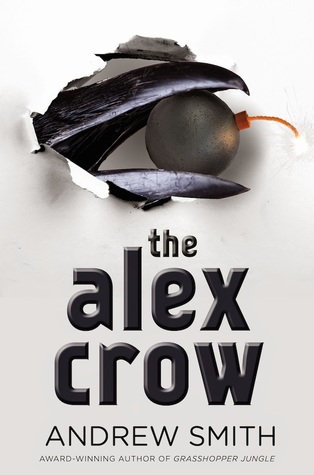
The Alex Crow by Andrew Smith

Ariel, a refugee who is the lone survivor of a massacre in his village who now finds himself living in Sunday, West Virginia.  Journal entries taken from the journal of the navigator of an Arctic expedition (appropriately name the Alex Crow expedition) over 125 years ago.  The melting man, a schizophrenic bomber out to get the Beaver King.  Then there’s the reincarnated, bionic, and suicidally depressed crow.  The Alex Crow weaves together multiple narratives to bring you a story of survival, brotherly love, morally questionable science, and the Dumpling Man.


Though not a completely negative trait of this story, The Alex Crow is different from Smith’s previous books.  Different is not bad, but when you go into a book expecting one thing and getting another you can be caught off guard.  This book, while still holding many of the same excellent qualities of Smith’s other books—its insightfulness, simultaneously serious yet ridiculous aspects, and overall good writing—some aspects of the stories almost felt lacking.  Yes, a schizophrenic bomber, a failed Arctic expedition, a refugee, and some morally questionable science can make for an interesting read.  These stories also don’t take place within the same time, the same place, or even around the same person.  Taken by itself, that can be an exciting quality in a book but in the case of The Alex Crow the content fell a bit flat.

There are some narrative bits that deviate from this but, for the most part, The Alex Crow is told from three main perspectives.  There is the main one, following Ariel, and two other secondary stories: one following the navigator of the late 19th century Alex Crow Arctic expedition via journal entries and the other following a schizophrenic bomber.  While the connections made from the secondary stories to the first are fun, overall they didn’t add much other than length.  Does a cool ending or tie-in validate storylines that needlessly break up an interesting main story?  My answer is no. 

First let’s look at Ariel’s story.  Now here is a good story.  Here’s a kid who, by a couple strokes of luck, manages to survive the complete and utter massacre of his village—which is located somewhere on the other side of the plan and, given the time the story takes place, the US military involvement, and the names of the people who live in the area, I think it’s safe to assume it’s somewhere in the Middle East.  Then he spends time traveling/surviving with some US troops.  Then with varying groups of refugees.  Then back with the military.  Then is adopted by an American family.  Then is thrown into a summer camp for kids who have become addicted to technology.  Next, throw in the fact that his father works for a company where he is one of the leads in working on de-extinction and other mad-scientist level experiments, as well as some questionably real urban myths.  There’s a lot there for a good story.  His story provides current day narrative, as well as retelling of events from the massacre until they finally catch up with the events of the book.  There’s an awesome base for an amazing story right there, then mix in Smith’s flare for the bizarre and you have yourself an outstanding adventure.

It’s when the other two stories are thrown in that the book started to seem a bit odd, and not in the good way.  The expedition and schizo-bomber were seemingly added for no other reason than cool tie-ins, lone elements that would not detrimentally impact the main story at all were they missing.  As I got through the book I wondered what importance they might hold but, by the end, the expedition story was made redundant almost instantly, and the schizo-bomber wouldn’t have changed anything with his lack of presence. 

The first of those, the Alex Crow expedition, by itself could have made for an interesting read on an online forum, maybe even in a book that had a more direct and active relation to the pseudo-historical events described in the journal entries.  It could have also made a good horror/thriller novel, depending on the route taken with the information it held.  As a complete story, I may have even liked it more than Alex Crow.  The story, as it’s delivered to the reader, is so broken up that any impact it may have had on the reader is taken away.  The information it held played into the story slightly, but only to the point of a few “oh, that’s neat” and “huh, well what do you know” moments. 

The second, that of the schizophrenic bomber, had the same impact as the expedition arc.  By itself it also would have made for an interesting read on an online forum (though most likely a different forum than the expedition would be found on).  All in all, even though I wanted to know just what relevancy his character had to the story, and even though I enjoyed how these sections were written, I couldn’t help but groan when I saw I’d arrived at one of his moments.  The tie in was neat but didn’t have any impact and, again, held no overall relevancy to the story as a whole. 

I want to be clear on this point.  I enjoyed the expedition story—I even wish there was more of it because of my level of enjoyment—and liked the schizophrenia story.  They were fun to read.  At the same time it seemed like they were ideas for stand-alone stories that didn’t come to fruition so, instead, they were tacked onto Alex Crow because someone in the publishing process liked them enough.  With the back and forth between the various storylines of varying qualities, these mostly unnecessary storylines distracted too much from what mattered and diminished much of the excitement that might otherwise have come about.  Throughout the story, knowing Smith’s writing, I was positive that they’d all tie together in some way.  I just didn’t care.

Even though aspects of the story didn’t appeal to me (though Ariel’s story did to a large degree), I still enjoyed the mechanics of it.  The way multiple semi-unrelated stories were told together with odd interweavings was fun.  Taken in parts the book was incredibly exciting, interesting, fun, and thoughtful.  Yet, when all of those parts were put together it somehow lost something.  At the end of the day, the biggest problem is that there were some well written and interesting but overall pointless side stories.  Nevertheless, although the story is a bit different than I expected, The Alex Crow is a well-written book that could very easily appeal to fans of good writing as well as fans of good stories.  Ever present in Smith’s writing is his easily identifiable narrative voice.  For anyone who hasn’t read any of Smith’s works, which I recommend you do, it’s as though the narrator of the story is aware that they’re telling a story but they’re not really talking to anyone (except for the times that they clearly are).  The diction and syntax just happen to work that way and it makes the experience of reading that much more pleasant.  If nothing else, the physical act of reading the words on the page will be relaxing.

If you’ve read and enjoyed Smith’s previous stories by no means should you skip this book.  Smith maintains his positions as one of the top YA authors, appropriately making this perfect for any fans of YA fiction out there.  Likewise, I’d recommend this book for any historical or science fiction fans because—even though they’re a bit hidden—the sci-fi and pseudo-historical elements in this book should keep your interest.

Rating: 3.5/5

Sunday, June 28, 2015

Lexicon by Max Barry

In the secret world of the poets—humans that, through the power of language, have gained the ability of human compulsion—Max Berry delivers us Emily Ruff and Wil Jamieson.  The first narrative arc belongs to that of Emily, a sixteen year old girl making a living by hustling card games on the streets of San Francisco, able to analyze her marks to a frightening degree. Frightening enough that the poets have sought her out.  As her life quickly takes an unexpected turn, she finds herself at a private, and secret, school where she will learn all she needs in order to sway anyone to her will.  Every human has a unique ‘code,’ a sequence of four special words that allow the speaker access to their thoughts and will.  Through studying an individual, the poets are able to categorize them, determining just what specific order of words will unlock their mind.  This new world is a world of specific rules, rules that must never be broken and Emily, Emily has no small problems with following rules.  The second narrative arc follows that of Wil, a young man who finds himself thrown into a supposed poet war.  With no clue as to why he’s been dragged into this fight, the only information the reader is given is that Wil’s memory has been compromised and that something horrible happened in a place called Broken Hill, Australia.

In Max Berry’s Lexicon we are in a world, very much like our own, but within it lies a secret organization of poets, each member given the name of a famous poet to act as their code name.  “The pen is mightier than the sword.”  The adage about the superiority of language, of words, over any amount of force is expanded upon within this book.  More than mere wordsmiths, these poets have such vast knowledge over the human psyche that, with the right words, they can compel any human being to do whatever they wish them to do.

The two key phrases found throughout the book are “’Tower of Babel’ event” and “barewords,” with the latter causing the former.  Normal coercion requires that a poet analyze an individual’s personality to determine what precise sequence of four words it will take to be able to control the individual.  Being aware of this ability, many poets have built up defenses to protect themselves from other poets.  With the use of these barewords, none of that matters.  Merely looking at the word makes an individual susceptible to coercion and worse.  The best way to think of an uncontained bareword, in this case inscribed on a small object, is as if a nuclear reactor had melted down.  And with the complete release of a bareword is a Tower of Babel event, resulting in the destruction of all language.  Honestly, while it seems daunting, I would have liked if the book had gone into more detail here.

Emily has been living on the streets, using card games and her innate ability to analyze and understand people to make enough money to get by.  It was a character introduction that was neither good nor bad, but it was well constructed.  Once we get to her developing her abilities to become a poet and her use of those abilities, whether likeable or not, I appreciated Emily’s comparative difference to those that surrounded her, as well as other young protagonists in their own stories.  Since others around her succeeded where she did not, using abilities and other natural talents that she didn’t possess, she used the skills that she did possess to their fullest in order to fight against that imbalance.  That use of skills was excellent to see in place of the luck of many other main characters, characters who only manage to succeed because of coincidental events rather than their own planning and abilities.

Wil finds himself at the center of a war between poets, only knowing that something horrible has happened at Broken Hill.  Fresh off a plane he’s both kidnapped and protected by two strange men, who drag him towards a place he has no recollection of.  I can’t say whether Wil’s character seemed too whiny, or if it was the right amount of complaint coming from someone in his particular situation.  While I’d like to, I can’t talk too much about the progression of his character or I’d risk spoiling something for you.  It is through Wil’s character that many of the mysteries of the story are revealed, so in that I would call him more of a device than an actual character.  So while the writing behind him was strong, it was hard to shake the impression of him functioning as a tool rather than a person.

The story itself, the way that the narrative jumped back and forth between Emily and Wil, was highly enjoyable.  On one hand you have Emily who is able to learn about the world of the poets as she tries to find her place.  On the other you have Wil who is dragged in head first with little to no ability to act on his own.  The two stories both involve the unifying thread of the poets, yet while Emily finds herself in relative peace, Wil’s perspective of their world is pure chaos.  The world that Emily couldn’t see, yet Wil could, was enjoyable as a reader.  However, as mentioned above, Wil functioned more as device than person.  Had the two stories been separated, Emily’s story would have succeeded and made sense while Wil’s would not have.  And yes, that’s an unfair point to examine as this story is not two individual stories, but one made from intertwined arcs. 

This was a story where I caught myself off-guard by my own enjoyment.  As characters, neither Emily nor Wil excited me in any special way, but the story itself is what pulled me along.  The world that existed within the pages of Lexicon and the laws that governed it was one that I could definitely have no problem reading more into.  While the story focused primarily on Emily and Wil, there were also times went it delved more deeply into the world of the poets, specifically through the eyes of Yeats.  While I can’t give too much away, seeing things through his eyes would make for an exceptional story and, if you’re anything like me, you’ll definitely appreciate what Barry made in Yeats.

The story itself is both exciting and fresh, detached from the typical physical action packed story that make up many fictitious thrillers.  It’s a story where the good and bad guys alike rely on their words as much as their physical actions in order to drive the story.  A story where a word has the power to change the world.  Where words are the most powerful weapon.

In previous reviews I’ve mentioned events that I haven’t wanted to spoil.  In the case of Max Berry’s “Lexicon,” the ending is something else entirely.  Now, before the end there will definitely be readers who are able to predict what the ending holds.  However, whether you see the ending coming or not, you’ll definitely get a kick out of it.  If you fall into the first group or the second, the writing and storytelling that Berry utilizes to make the ending work as beautifully as it does is something to be admired.  That being said, when looking at the story as a whole, there were parts of Emily and Wil’s adventure that could have gone differently, even better, had Barry not been trying to arrive at the ending he did.  So it’s a hard thought on whether or not the end justifies the means.  Although, the way that Emily and Wil’s arcs are woven together is just breath-taking.

Lexicon is one of a growing number of conspiracy thrillers, so I would accordingly recommend this to any reader who takes pleasure in thrillers, mystery, or conspiracy.  That isn’t to leave out all those who enjoy science fiction and paranormal.  If you’re an avid reader, then this book is a must for your reading list!

Rating 4/5

Sunday, June 21, 2015

The Dead Lands by Benjamin Percy


Amidst the now dead United States—humanity and other forms of life nearly wiped out 150 years ago by a deadly pandemic and nuclear fallout—sits a small town, the Sanctuary, located in what was formerly known as St. Louis. From this desolate wasteland, a lone female rider appears from the land beyond its walls, land which, up to this point, has been described as holding nothing but death.  The people of the Sanctuary have been ruled by fear, under the thumb of the corrupt leader, Thomas Lancer.  With the appearance of this rider, Gawea, comes her promise of a better world, a promise that Thomas tries to silence in order to maintain his power, forcing Lewis Meriweather and Mina Clark, among others, to save her and find salvation for their town on their own, outside the walls, crossing 2000 miles/3200 kilometres by horse and foot.  With the possibility of water, of a way to save the people of the Sanctuary from the drought and famine, they have no choice but to follow this mysterious girl to Oregon.  And after all that time and radiation, both from the fallout and UV exposure due to the vanished ozone…things have changed.

I can honestly say that when I first picked up this book, I didn’t know what to expect from it. It seemed like it had promise, the title of The Dead Lands alone caught my interest, though that is definitely more a personal interest than anything else.  When I saw that it had a quote from Stephen King's review that was definitely not a negative factor in its favour, but I can’t say it swayed my decision too much [so…good job for the editor and publishing company there].  However, I have to say I’m very glad I picked it up.  The book started out leaving me slightly unsure, a little bit confused as to how it would go, but interested nonetheless.  It’s also a story told from numerous perspectives and, while it wasn’t something I’d expected, anything told from at least three viewpoints, three well-written viewpoints, always wins points in my book.  This is your atypically typical dystopian fiction story.  When I read the brief description of the book I was expecting a much different kind of dystopian fiction novel.  I won’t get into how it differed, because I don’t want to ruin the surprise that I received when I read it.  What I can say is that it was enjoyable, it was fresh, and that the slight difference from typical dystopian fiction novels kept me highly interested.

There are several key characters in this story, resulting in several points of view that the reader is able to see from, and I would have trouble determining who I thought the best one was.  Each had minor flaws (not personality flaws, but flaws in how they were constructed), some of the slightly less important ones bordering stereotypical and boring at points, but the very least I can say is that none of the characters were bad (morally, yes, but not in the way they were written).  They were nicely crafted, had their share of character flaws, and felt more real than placeholders.  I should probably address the fact that the two most central main character were named Lewis and Clark.  Yes, this is essentially a retelling of their exploration.  At the same time, I’m fairly certain nothing would’ve been lost by given them different names (among other details of the story that closely tied into the real life Lewis and Clark).  I mean, it’s definitely a fun detail, to say the least, but at the same time I can’t tell if it seems a bit too forced.  A bit too on the nose.

BEWARE, SOME SPOILERS BELOW BUT THESE ARE SOME POINTS I’D LIKE TO ADDRESS.  I’LL MAKE IT EASY TO SKIP PAST IF YOU DON’T WANT TO SEE.
*
*
*
*
*
*

Magic and Wizardry.  Essentially, this book combines dystopian fiction and, what I saw as, Arthurian fantasy.  So for anyone out there, anyone out there who has wondered at the possibility of human kind being able to develop magical abilities, this book, by means of using a hundred and fifty years, radiation, a mysterious illness, evolution, or some bizarre combination of these things, has allowed for that world to be created.  The world has ended, society has collapsed, pockets of humanity have managed to come together and stay alive, preventing the eradication of the human race, and in that time wizards are born.  Two of the main protagonists, Lewis and Gawea have what can only be described as magic powers, and they’re not the only ones.  They’re explained as effects of evolution/mutation, so maybe that’d be a bit more accurate way to describe their abilities, but I’m sticking with magic.

Alright, that might be a bit of a stretch, but it was my first reaction to the story. 

While there’s the obvious Lewis and Clark retelling in this story (Re-imaginings of Lewis, Clark, Sacagawea, Thomas Jefferson, Aaron Burr, John Colter. I also looked at what could have been some overlay with the King Arthur lore, this being one of many great quests.  Thomas as Uther Pendragon, Lewis as Arthur, Aran Burr as Merlin, Gawea as Morgana, the Sanctuary as Camelot, something like that.  There were some other connections that I saw between the stories, but I only have a precursory knowledge of Arthurian lore.  I’d love to have someone highly knowledgeable in it read and analyze The Dead Lands to see what, if any, connections could be made.
*
*
*
*
*
*

OKAY, IT’S SAFE TO READ AGAIN, THE EVIL SPOILERS ARE HIDDEN AWAY AND CAN’T HURT YOU ANYMORE, I PROMISE.

As for the special twist in this dystopian fiction that makes it different from many others, I can honestly say I had no clue that would lead me to expect what happened.  When I read a dystopian fiction, I expect to see a very close to life, a very similar world, to the one I currently live in.  While this story does have that, it also has something more, and that thing that it has, that little something more, makes this book something that is unique.  It’s not bursting with uniqueness, but it has a spark and, whether or not you enjoy the genre(s) that this book falls into, to find uniqueness in literature is fairly rare.  I think, for that fact alone, this books is special.  But that specialness, that examination of the book based solely on its uniqueness, only really applies to those with no particular interest in this genre.  For those who actually have an interest in the dystopian fiction, science fiction, fantasy novel world, this book is damned amazing.

Overall, the story is, in the most general analysis of it, fairly standard.  With increasing saturation of the dystopian fiction, The Dead Lands tells a common story of life on Earth after society as we know it crumbles.  There’re a group of people who band together and, while dealing with numerous hardships, strive to complete their goal of surviving/saving other people.  While they try and do this thing, there is a bad guy who is doing something counter to what they wish to achieve.  I’m doing a lot of generalizing, but that’s the story.  Let’s be honest, that’s most of these stories, different bodies on the same skeletal structure.  However, while this story arc is fairly common, the twist that Benjamin Percy puts onto this story is highly enjoyable, and livens up this dystopian fiction.

While I love the story, there are parts of the writing that rubbed me the wrong way at point.  Mainly the progression of events in Lewis, Clark, and company’s journey.  Several months (passing a year potentially) pass over the course of this story, as the group is traveling 2000 miles/3200 kilometres by horse and foot across an irradiate wasteland.  That being the case, I understand how, when the viewpoint changes from that of one in the group to that of one still in the Sanctuary, and back again, the group has moved forward in time days, weeks, months.  Since they do, obviously things will have changed both within the individual and within the interworkings of the group, yet some additional explanation could be used, rather than the “well this is obviously how things would change” moments that are there.

The cast of good guys is lengthy and fairly diverse.  I could go off, listing each by name and talking about them but I’d rather talk about the bad guys, and this is already turning into a long review.  So, for the good guys, I’ll say that they’re all pretty interesting, mostly well-written, and I enjoyed them.  Same for the ‘neutral’ characters, or ones who shifted from one side to the other.  Now onto the bad guys.  Without getting spoiler-y, I’ll stick to the two main ones, Thomas and Slade.  While I, at first, enjoyed Thomas’ immature and youthful brand of bad-guy-ness, it quickly grew old and unbelievable.  When someone acts the way he does, you would expect that he would have the power to ensure that he can continue doing what he wants to do, no matter how foul.  Yet, he has almost no real power.  Slade, another crazy, listens and largely obeys him, but he’s one man in a city of thousands and Thomas has virtually no other allies among the citizens, the guards, the council, or…other places that I don’t want to mention for fear of spoiling more than I already may have.  The point is, he stays in power merely for the point of being an antagonistic force despite having very little believable and rational explanation for his continued success. 

As for Slade, he’s a well-written, if stereotypical, crazy bad guy.  He’s the head of the police force with a good amount of respect/obedience to stay in his position of power, though he comes off as a cut-and-paste Buffalo Bill.  He also likes the position he’s in, which is the only reason I can think for him to listen to Thomas, the man who allows him to do what he wants.  His misdeeds and grievances are rational (to him) and the string of reasoning he uses is evident to the reader so, while they may not sympathize with him, they can understand why and how he rationalizes doing what he does.  Taken together, they provide the drama back in the Sanctuary but, while that drama is entertaining and nicely breaks up the story of the journey, it seems insincere and too unbelievable.  Unfortunately, since this story makes up half of the world the reader experiences, that’s a major blow to the overall book

The story ends on a good moral note, in that it presents you with differing moral standpoints and, though Percy clearly chooses what the perceived correct one is by way of story progression, the opposing or “wrong” morals still make you stop and think about it.  Most of all, I was stuck wondering if I would have made the same choice that Lewis made and, if so, what would my reasoning have been.  Yet, even with that good quality, after everything that I’d been through, the ending felt rushed.  After carefully thinking about it, what I had initially thought was just a dislike for how The Dead Lands ended turned out to be a dislike for the comparative lack of substance that the ending possessed.  Not the epilogue, mind you, which I thought had a fun cliffhanger (though one that I think should be left alone, keeping this a stand-alone novel), but the end of the journey that took several months and a couple hundred pages.

I would be remiss if I didn’t recommend this story to anyone who is interested in dystopian fiction, fiction, fantasy, science fiction, manifest destiny, survival stories, and the list goes on.  Percy’s The Dead Lands is a book that I highly enjoyed and the time I spent reading it I don’t lament in the least.  It was time spent its existence for a good purpose.  Lacking any sense of elegancy, the best way, I feel, to describe this book is as follows:  it was really, REALLY cool.


Rating: 4/5

Sunday, May 17, 2015

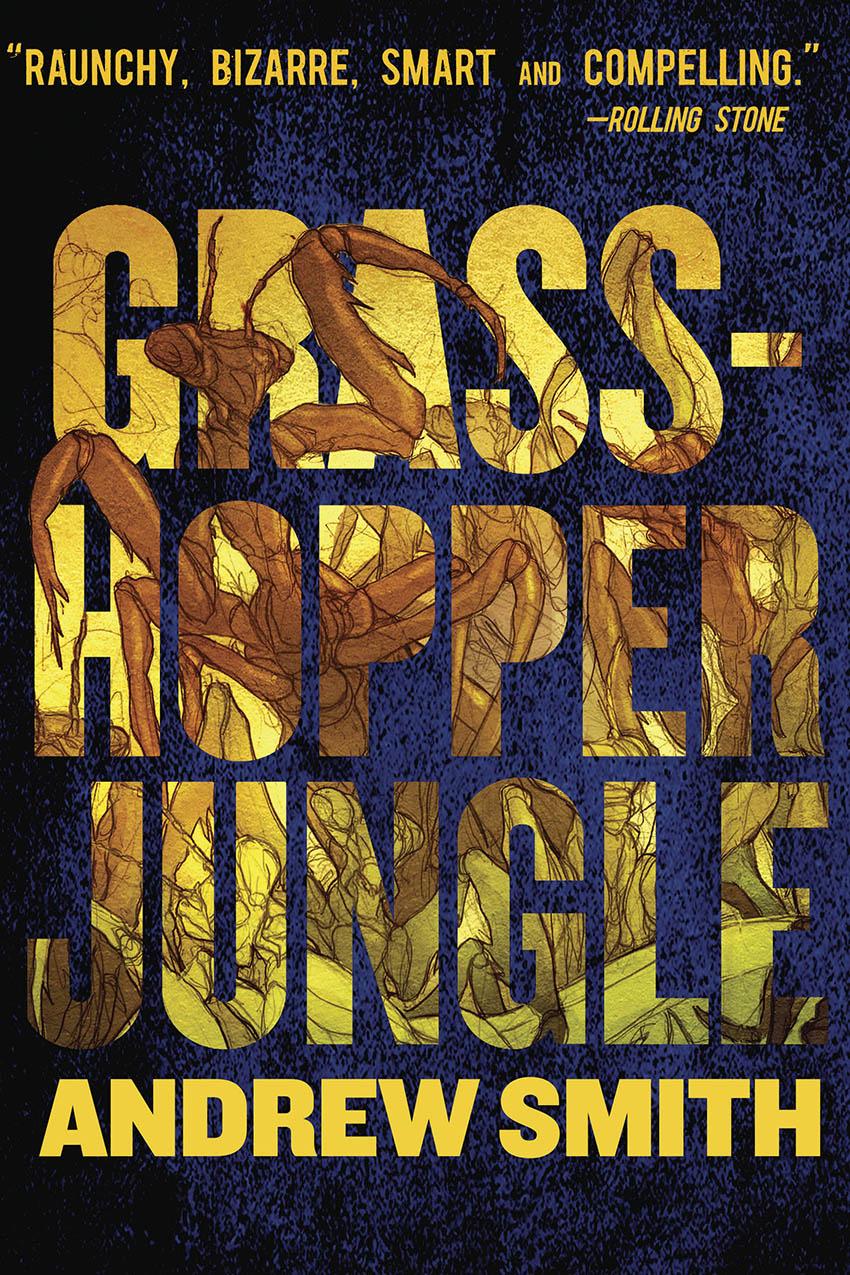
Grasshopper Jungle by Andrew Smith

Grasshopper Jungle is set in modern, poverty stricken Ealing, Iowa and narrated by Austin Szerba.  Sex and sexuality, adults, bullies, [censored], and sex. Austin and Robby, retrieving some items placed on the roof of the local mall by a group of bullies, decide to slip into “From Attic to Seller Consignment Store” where they see [censored], [censored], [censored], and [censored].  While in the store, the group of bullies break in and [censored].  As they sneak out, making sure to avoid the group of bullies, they see [censored], setting off a strange chain of events that [censored].


You’re probably wondering why I did that to the story’s summary. Spoilers are one of my biggest pet peeves, whether it applies to books, movies, games, anything.  Hate ‘em.  Don’t want ‘em near me, don’t wanna look at ‘em. I wish all spoilers would just die.  Okay, that last bit might be a bit of an exaggeration, but it irritates me to no end when I read the back of a book or the inside sleeve of a book gives away crucial information.  If I could go on and on about how much I hate spoilers, I would, complete with an extensive multimedia presentation.  However, I won’t because I’m talking about Grasshopper Jungle right now.  The reason I bring up my disdain for spoilers is because of what would have been ruined for me in this book had I known about it prior.  Nothing that would have destroyed my experience, but it would have taken away something special.  In keeping with that I have made the summary I normally include short and vague.  I want all you potential readers to have that same moment I did.  To best describe that moment, I’ll say this:  I never saw anything but the title of Simon Pegg’s The World End before I watched the movie.  My feelings of unadulterated bewilderment and pure glee when “the shift” happened (I’m hoping this is explanatory enough) in that movie perfectly mirror my reactions when I read this book.  Now that I’ve finished the book and read the back (basically, now that I’ve looked at even the most precursory information about this book) I see it’s actually not that a surprising a shift (much like World’s End wasn’t if anyone saw even a single trailer or looked at the movie posters).  However, I went into this book with only my experience of his earlier books—Ghost Medicine, Passenger, In the Path of Falling Objects—playing into what I expected out of this book (If I’d remembered Marbury Lens I may have seen it coming).  So, if possible, I’d like to give you the same experience I had.  Smith is great at writing captivating coming of age stories, and Grasshopper Jungle is that and more.  For first time Andrew Smith readers, this book is as excellent a place to start as any.

Now that I’ve finished belaboring that single part, I’ll actually get into the actual review.  Sex. Boom, the reader’s hooked.  This is a great coming of age story that, among the many factors to come, isn’t afraid to be in the head of an adolescent boy and elaborate on all of his thoughts.  A few of those thoughts aren’t even about sex.  Along with Austin’s many mixed feelings towards sex and sexuality, his overall attitude towards friends, romantic interests, adults, and bullies are dead on and I would challenge any reader to say that they can’t find a single instance in the story where they aren’t taken back to a similar moment in their own adolescence. [As this is a male character and I’m male, I can’t speak from experience, but I’d wager that this also applies true to females as well.]  The narrative style is that of first person train-of-thought for 10th grade Austin Szerba, and I can’t imagine any other form being this captivating.  There’s always the issue that train-of-thought writing might sound too manufactured or it might be too erratic, but Smith has succeeded in spades.  Also, did I mention that Austin is very, very horny?

As a science fiction, Grasshopper Jungle is almost required to speak to some real modern day issue by way of its sci-fi narrative.   Grasshopper Jungle addresses sexuality in a way that isn’t typically addressed in YA fiction outside of novel solely dedicated to that topic.  This helps pull the topic from sensitive subject matter and makes it part of normal conversation so, regardless of the quality of the story (which is exceptionally high), the impact this book has and will have gets it major points in my book.  It’s clear in every one of his novels, but Smith has an interestingly profound understanding of what it is to be a teenage boy.

The quips and overall comedic tone in here are great.  They’re not forced, they’re clever, they’re fun, and they’re plentiful.  I started with a small list of lines that I thought about including here, but after I’d accumulated a couple dozen from the first forty pages alone (out of nearly four hundred) I realized that the list might exceed the length of the rest of my review.  Not a page will go by that you don’t chuckle, at the very least.  They also make sense, working with the established voice of the story and making the reader enjoy the act of reading while not pulling them out of the story.  Hell, forget quips, it’s all funny, the whole damn book.  And in every single chuckle and thoughtful moment of the book, there are hardly any “book” moments, and when I say “book” moments, I mean events that could only happen in a book.  Thinking them over, I could see them all happening in real life (well…with some obvious exceptions).  There’s a life in this book, making it more than a story and making it incredibly clear that no one could finish this book being worse off.

The premise of the story (and yes, this will be vague) is one we’ve all heard before.  Important/relevant older figure has store with strange odds and ends.  Kids break in.  Kids find things hidden away off main store floor.  Kids witness object’s misuse.  Chaos/plot ensues.  It’s a solid angle that works and Smith puts his own flourish on it.  The characters, primarily Austin and Robby, are also constructed incredibly well, coming off as intelligent and self-aware while being believable as teenagers, not appearing as teenage puppets worked by their adult and experienced creator. 

“The shift” that I referred to earlier—the cause of my vagueness and, most likely, your irritation towards how unhelpful my review is—results in one of the mostly calmingly surreal stories I’ve read in a while.  There is no loss in teenage awkwardness, no overselling of certain emotions, and the ending is a blast.

I’d recommend this book to anyone who enjoys slice-of-life stories, science fiction, and chuckles, as well as anyone dealing with, or trying to understand, teenager-hood.  Actually, I’d recommend this to anyone of any age who likes a good, fun story.  This is, at least, one of my top five YA novels.  Now, while you go read Grasshopper Jungle, I think I’ll go check out Alex Crow…


Rating: 4/5

Sunday, April 19, 2015

172 Hours on the Moon by Johan Harstad

172 Hours on the Moon (or DARLAH) follows the standard moon-themed horror story—there’s a reason humanity never returned to our closest spatial neighbor. It’s a good reason, too. However, in order to regain access to an old research base known as DARLAH 2, we must return. 
This is the premise that precedes humanities return to the moon in this space horror. Hidden powers in the United States government clamor for a means to return to the moon and reclaim the old research base and any mysteries it holds.  To accomplish this, however, they need to garner public appeal so as to avoid suspicion as well as raise the proper funding. In order to rekindle the world’s passion for space exploration, these powers begin a lottery to select three teenagers, age fourteen to eighteen, to send into space.  For a fulfilling life, for escaping failed love, for fame and fortune.  These are the reasons that Mia, Midori, and Antione have decided to venture into space, hoping that by doing so, they can use this as a means to accomplish their goals.  Although they aren’t traveling alone, accompanied by fully trained and accomplished astronauts, what they find up there may just be worse than any could have imagined.

First and foremost, I really, really wanted to like this book.  It has everything a good YA book needs: fleshed out characters from diverse backgrounds; an interesting setting; (relative to Earth) dreams, goals, and troubles that are relatable to its audience; and its adherence to the genre.  “Even though it’s just YA,” he says, irritated at all those who say YA should be ignored after you turn 18, the horror in this book was phenomenal.

Mia, from Norway, is a rebellious teen whose parents sign her up for the lottery against her wishes.  After thinking about the opportunity, she decides to turn this experience into a platform to launch her and her band’s music career.

Antoine wants to travel to the moon to get [I’m so, so sorry] some space after his girlfriend breaks up with him to be with someone else.  And of course, he’s French, because what other nationality could a character so perfectly heartbroken be.  He gives off a bit of a stalker-y vibe, but other than that he’s a nice kid…

Midori is a fashionista who hopes to leave the repressive culture in Japan, fearing the life that she knows she will inevitably fall into as a female.   She believes that New York is where she can live the life she’s always dreamed of, and by traveling to the moon by way of NASA’s training camp, she will take her first step out of Japan for good.

They’re solid characters and, though they may have some minor flaws as far as stereotypical qualities go, Mia, Antoine, and Midori all bring something different to the story.  Taken together, they’re a good crew to follow along on this adventure.

Last but not least, we have what I’d like to refer to as, the special character.  With only minor appearances in the book, though detached from the main story, we’re given a senile old man named Oleg Himmelfarb.  Old Himmelfarb used to be a janitor at the facility that was in charge of creating DARLAH 2.  Working there he learned something and, while he may not remember much of his past now, or even where he lives, he still knows enough to be terrified of humanity’s return to the moon.   Though not highly involved in the story, his involvement is useful in bring a sense of danger to the readers’ attention early on, before any truly frightening scenes begin.  I would have liked to have had a couple more chapters with him as the central character.  Aside from him simply being a fun character, even another short chapter could have gone a long way in building suspense.

When the teens are still on Earth, Mia, Midori, and Antoine come across messages, codes, and warnings, all with one common link.  Don’t go. 

Despite the story’s slow approach to the actual horror aspects, I greatly enjoyed the contrast between the comparatively lengthier portion that proceeded the horror and the actual horror portion itself.  While the beginning of the story was relatively normal, setting the tone of the story much more as that of a drama/science fiction novel than that of horror/science fiction, it provided excellent buildup and foreshadowing.  I should also point out that this is less a mix of horror and science fiction, and more a horror story with science fiction elements.  As soon as the frightening events started occurring—I’ll leave this vague since spoilers are even worse when horror is involved—I became incredibly panicked, worrying about what would happen to Mia, Midori, and Antione.  To call the ending eerie would be an understatement.

However, 172 runs into the problem of having a lot happening but lacking the space to fully address it all.  While the characters are all interesting, due to constraints of size, they aren’t explored as much as they should be to add to the world of the story.  The diluted plot did a lot to take away from the legitimately terrifying moments in the book.   Harstad also skips over a several month long period of time, which would have been a great place to see relationships form and characters develop.  Even if it was only mentioned shortly, who doesn’t love a good montage?

Then we come to the plot holes…this is awkward.  There are some plot holes centered on events that occur to and around the three teenagers, some with the whole reason for going, some that I can’t even vaguely touch on without spoiling one of the key horror elements of this piece.  It’s difficult to talk about these events without spoiling anything, but suffice to say there are a few, the cause of which seem to be of the standard variety:  they’re there because the story needed to happen.  The plot holes in question, while a bit distracting, don’t hurt the story much and I can’t imagine the story without theses points.  Sure they could have been avoided with some explanation later on, but they’re minor and simple enough to overlook.

This is by no means a short book (at roughly 370 pages), yet I found myself finishing it faster than other books its size due to the speed at which I was pulled through, grasping at pages as I raced to see what would happen next.  A must read for any horror buffs, but expect to be frightened of crowds for the foreseeable future.  And the person currently sitting to your left.

Rating 4/5