Showing posts with label Romance. Show all posts

Wednesday, February 3, 2016

The Darkest Minds by Alexandra Bracken

In The Darkest Minds, the first installment of The Darkest Minds Trilogy, we are introduced to a world afflicted by the IAAN disease, short for Idiopathic Adolescent Acute Neurodegeneration.  Only affecting children in the early stages of puberty, this disease results in the death of nearly every child in America.  Those that manage to survivor find themselves with one of five strange psychokinetic powers: hyper-intelligence (labeled a Green), telekinesis (Blue), electrokinesis (Yellow), pyrokinesis (Red), and mind control (Orange).  Under the guise of rehabilitation, all children who managed to survive IAAN, now labeled as “psi,” are rounded up and placed into camps, where they are kept under strict control and prevented from using their abilities.  It’s on Ruby’s tenth birthday that she inadvertently uses her new found abilities as an Orange and is soon taken to one such camp.  She manages to remain undetected by masquerading as a Green for six years but is forced to flee with the help of an anti-governmental group, The Children’s League.  It isn’t long until she realizes they aren’t what they seem and is on the run again, managing to escape with a small group of renegade kids off in search of a safe haven for all those labeled as psi.  But is the sanctuary everything it seems, or is it merely a staging area for greater forces?


There’s no denying that this is an exciting YA trilogy.  In today’s market dystopian fiction and superpowers are an immensely popular combination that, if written well, are sure to find a thrilled audience.  Sadly, The Darkest Minds doesn’t really hold much under the surface.  There’s a story being told and the coming-of-age lessons that are trying to be told are clear, but the manner in which both are delivered leaves a lot to be desired.

Before delving into some of its problems, I want to say I don’t think that this is an awful book.  It’s well-written and, if you don’t think too much, the story is consistent within its own reality. Plus, some of the mutations/powers are fairly interesting.  I can also see the appeal to a reader audience who want either a) some story to encompass a romance and are just interested in the struggle of those involved with said romance or b) a coming-of-age story that, though fictitious, has qualities relatable to the real world.  In that regard, this story is better than a number of series on the market, thus far at least.

At the same time, this story does seem rather formulaic.  There is a clear-cut bad person/organization.  There is an opposing person/organization that seems good but, surprise, is actually just as bad.  There is another person/organization that is less powerful but is, ultimately, good.  Or is it?  [Insert ominously foreboding soundtrack here]  Then there is the main character who finds a small group of friends, all of whom just want to survive, free of the games of those who wish to use them as pawns or do them harm.  Ultimately, through a progression of events, the main character(s) grow and realize they can’t just run from the fight but must throw themselves into the fray for the greater good.

In any good story there will be complex characters who undergo some development – at least to some small degree in a story that’s part of a series. That being the case no character should be perfect, much less start out perfect.  That’s definitely not the case here, with a main character, Ruby, who is most definitely not perfect in a multitude of ways.  While there is some character growth, at the end of this trilogy’s first installment, Ruby has only grown into a likeable character.  This means that for the majority of the story, Ruby was altogether unbearable.  Given the scenario (which I’ll get into in a moment) Ruby acting the way she does is believable.  However, believable doesn’t mean good.  It’s one thing to write a character who is believable and another thing entirely to write a believable character that people are actually interested in reading about, following, and cheering on.

The scenario for this world is difficult to swallow.  Simply put, bad guys are bad because bad guys have to be bad.  There isn’t a lot of legitimate reasoning behind why the villains are acting like villains other than the story needs an antagonistic force for the reader to be aware of. The reasoning behind the main conflict, locking up all the children because they are powerful (which goes into the whole ‘fearing what you don’t understand’), only makes sense if you don’t actually think about it.  When all your country’s children are infected with something, locking them all up in prison camps without looking for a way to cure them seems like a good way to effectively set an expiration date on your country.  Plus, too much of the story is a road trip.  It’s interspersed by some moments of actions and exposition, but it’s too drawn out and makes it difficult to stay with the story without hoping for something else to happen already.

Now, maybe Ruby gets more complex and bearable in the following story.  Maybe the villains become more complex.  Maybe the reasoning becomes more apparent.  I have strong doubts about that last point, but the first two are possible.  However, there has to be a reason to want to read more and look for that explanation.  A good assessment of something should encompass the whole of its part but, while I am curious, there’s no incentive that’s provided to actually keep the reader going.  It’s out of sheer curiosity about why this series has the popularity it does that I’ll read the second novel, and nothing more.

As I said before, this story has merits when not examined too deeply, and I can see the appeal it might have to specific audiences (ones I personally don’t fall into).  While I might not recommend this story as heartily as other YA series, this isn’t a book that I’d outright dissuade someone from reading.  Fair warning though, don’t expect too much.

Rating: 2/5
Sunday, May 24, 2015

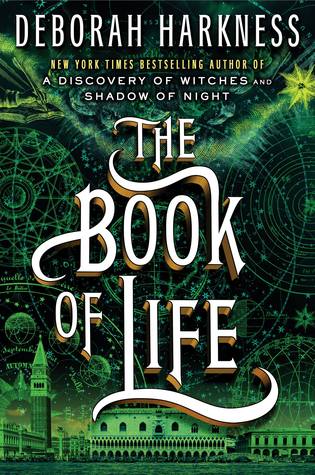
The Book of Life by Deborah Harkness

Warning!  Do not read this story until you’ve read A Discovery of Witches and Shadow of Night!


Once again, before beginning, for anyone who hasn’t read A Discovery of Witches and Shadow of Night, I recommend brushing up.  The books are very detail heavy and hold one long continuous story.  For anyone who hasn’t read either…this is not the starting point you are looking for.

After returning from 1590 Elizabethan London, the setting of Shadow of Night, Diana Bishop and Matthew Clairmont are back in the present, ready to finally uncover the mysteries contained in Ashmole 782.  They return to Matthew’s home in Sept-Tours, France with Diana nearing her due date.  As this wonderful moment of their life approaches, Diana, Matthew, along with their friends and family, must prepare for the dangers that arrive as they delve into the secrets of Ashmole 782, both within the Congregation, the council formed from all three supernatural groups, and without.  As secrets are uncovered, prepare yourself for the electrifying end of this expansive tale.


In A Discovery of Witches, the reader is introduced to Diana Bishop, alchemic historian and witch, and Matthew Clairmont, biochemist and 1500 year old vampire.  Together they pursue Ashmole 782, an ancient and mysterious tome sought after by witches, vampires and daemons for centuries.  Diana, reluctant to use her magic, has spent her life trying to push aside that part of her life.  However, with the appearance of this tome and Matthew’s romantic advances, she (as well as the reader) is brought into the world that she had spent her life trying to stay apart from.

In Shadow of Night, Diana and Matthew, in an effort to find some clue to the location of and mystery to Ashmole 782, travel back in time to 1590 Elizabethan London.  While searching, Diana also seeks out a fellow witch to help her understand her powerful, and dormant, magical abilities.  As they search for both tome and tutor, Matthew must reconcile his past life, a life that gives Diana a deeper understanding of Matthew, and his current, more mature mentality.

Finally, in The Book of Life, this uninterrupted trilogy comes to an end, as Diana and Matthew are once again in the present day, and the events surrounding Ashmole 782 come to a close.
In The Book of Life, the final installment of the All Souls Trilogy, there is a lot of new, but not unwarranted, information being thrown at the reader.  Events of the previous book have provided Diana and Matthew with new information that can only now be acted upon due to modern technology and, because of this, we get to see Chris again.  For those who don’t remember, Chris is Diana’s academic BFF introduced in A Discovery of Witches, and his small, but complex, character from the first book is fleshed out and he becomes an enjoyable secondary character.  And Chris is not alone in this, many other characters reprising their roles as they are brought to the foreground.  In the race to discover what secrets Ashmole 783 hides, there are no holds barred as a number of other characters take on life and import.

With the exception of the final section of the book (don’t worry, I’ll get to that) Harkness still writes with a loving attention to detail.  The world, events, and people will have you in rapture. Beautiful attention is paid to even the tiniest detail, and the complexities of the human (or otherwise) experience is wonderfully done.  Events of the prior books, and the time travel within, are given deeper meaning and brought to a neat and tidy close as the saga ends, leaving few loose ends for fans to wonder over.

Then there’s Diana.  Wow.  Finally, the culmination of all the witchy experiences the readers have seen as she traversed this timeline and, I’ve gotta say, it was definitely worth it.  To say I was 100% fine with how Diana and her powers turned out would be dishonest, but what I wanted would have been too strong a deviation from her already established character.  Given everything that the last two books, as well as prior events in this book, it’d be hard to find a reader that is legitimately disappointed.   

All notes of the fantastical and fictitious aside, the moral of this story is a timeless one that readers will, if current trends are to be believed, not tire of for generations to come.  Two lovers who shouldn’t be together are together and, despite the odds and opposition, they will fight tooth and nail to be true to themselves.

The primary downside of this book is the decrease of originality and life that the previous two had.  While this is definitely a strong book, it’s clear that it’s not quite as strong as the previous two (some weakness are overcome by the fact that this is a concluding piece, allowing for more possible points of merit than its predecessors).  Harkness loves history, which is made clear throughout the series and, while history has some play in The Book of Life, the strongest genre in this book is that of fantasy and fiction, rather than history.  Though entertaining, The Book of Life lacks the same level of scenic beauty and literal detail, many of the story’s subplots bordering cliché and trope-like.

The second downside of this book is the pace towards the finale.  Harkness has spent well over a thousand pages using loving detail to fully immerse the reader in this world and yet, when we come to the most crucial events, the concluding events that this entire story has been building up to…it’s rushed.  Any jumps in time taken previously were typically followed, at some point, by a summary of events that took place during that period, typically amounting to “this is why these events weren’t important for me to spend time on, you’re welcome” and the story was better for it.  However, nothing like that happens here.  Events, plans, and travels are rushed over and it feels more like Harkness is just trying to get to the end.  If it were any a number of other authors writing this, then I most likely wouldn’t have any problem with this but, since this is Harkness, I’ve come to expect a certain level of detail and care that just isn’t present.

All in all, it was an enjoyable end to the series.  While it wasn’t my favorite installment in the trilogy (though I had hoped it would be), it also wasn’t my least.  If you’ve read A Discovery of Witches and Shadow of Night you would be a fool to even consider skipping this book.  And to everyone who read this review knowing nothing about the prior two, if you’re a lover of words, fiction, fantasy, romance, vampires, witches, or history, then this is a must read.

Rating: 4/5

Sunday, April 26, 2015

Shadow of Night by Deborah Harkness

Warning! Do not read this story until you’ve read A Discovery of Witches!


Now, before I begin, for anyone who may have read the A Discovery of Witches close to its release and have taken some time to get to its sequel, I recommend brushing up.  It’s very detail heavy, so forgetting one bit of information could have you scratching your head for chapters.

Immediately following the events of A Discovery of Witches, Diana and Matthew have just timewalked to 1590 Elizabethan England.  There they hope to locate the intact Ashmole 782, find Diana a witch who can teach her how to best use her magic, and stay out of the Congregations watchful gaze.  Diana finds herself leaping feet first into the life of Matthew’s 500 years younger self, a world of spies, political struggles, and the ever mysterious School of Night, which includes such members as Christopher Marlowe and Sir Walter Raleigh.  While Diana attempts to find a proper tutor to aid her in mastering her magic, Matthew must deal with his own past, a life he thought would forever stay buried.  As they deal with their individual struggles, they must also do everything in their power to locate Ashmole 782, a tome whose true purpose slips further into mystery as their knowledge of it increases.


I was glad to finish Shadow of Night, part two in the All Souls Trilogy by Deborah Harkness, and find myself not too disappointed, as middle sequences of trilogies often leave me.  I greatly enjoyed A Discovery of Witches, and the few problems I had with it were largely fixed this time around.  While its prequel suffered from an excess of detail causing the story to progress at strange intervals, Shadow of Night was able to avoid those same problems.  Here the pace was even, the amount of detail used consistent throughout.

Starting this book I was looking forward to seeing Diana fully manifest her powers and abilities, as the previous book had alluded to the fact that they would very helpful against any of her or Matthew’s enemies.  The progression of her power development was very natural, taking time as she encountered natural roadblocks along the way.  My only complaint—and this is more of a gripe than a criticism, brought about by other stories typically not taking the route that Harkness did—was the lack of her power usage.  She has these spectacular powers and doesn’t use them.  But as her reasons for not using them align with her already very well establish mentality, I can’t say it’s a fault of the writer, but instead a fault of this reader.

The alternate history direction this book took was interesting, to say the least.  It wasn’t an outlandish direction for the book to take either, even though it’s a slightly different category than A Discovery of Witches fit into.  I was able to watch Diana interact with various predominant historical figures like Queen Elizabeth I, Rudolf II, Sir Walter Raleigh, and numerous others. Also, how she and Matthew became involved in various well-known historical events was both entertaining and eye-opening.  This is where Harkness’ historian chops shined brightest, as she wove Diana and Matthew’s path through the late 16th Century into historical blind spots.  While I read I had Google ready to go so I could fully appreciate the very real history used in this work of fiction, as I often stopped to look up dates, places, and people.

However, while Shadow of Night is a well-constructed book, it was a bit of a step down from its predecessor.

The first installment of the trilogy had the problem of losing the reader to the level of detail used in describing the scene, as well as pacing, but those points were largely corrected this time around, each scene an excellent balance of detail and action.  However, the pace at which the story progressed through the plot was incredibly slow.  There are a range of mini-story arcs in this book, but not enough to fully justify the length.  One part of me loved it, the way each day was described with such detail, allowing full immersion into the Diana’s life without losing track of what was actually happening.  The sensory details were amazing while not overpowering.  Unfortunately, the other part of me quickly grew tired of it, wanting some actual progress in the story to be made. 

Did the level of writing change or deteriorate throughout the story?  No.  Could this book have been much shorter without losing any of the power of the writing or skimping on key events?  Yes.  I’d say this is a problem of excellent skill in the wrong place.  This type of writing is perfect for contemporary fantasy, but there’s just too much writing.  If a book can be half the length and not lose anything in the plot, then there’s a problem.  Simultaneously, I like words, especially when they’re used to construct excellent sentences.  The writing is very pretty so I can’t dislike the book too much, even though the plot suffers heavily due to the stretching of events.  Regrettably, I’m going to have to rate the book placing higher emphasis on storytelling ability rather than appearance.

For anyone who enjoyed A Discovery of Witches, I am confident that they’ll equally enjoy Shadow of Night.  A historical fiction full of beautiful writing, this contemporary fantasy is a must read for any lovers of drama, the supernatural, historical fiction, or fantasy.


Rating 3/5

Sunday, April 5, 2015

A Discovery of Witches by Deborah Harkness

Let’s take a look to Deborah Harkness' A Discovery of Witches, part 1 in the All Souls Trilogy, or what I refer to as the book that should really have captivated the current Twilight fanbase (Yes, I know it came out afterwards, but time is just a construct).  Plot, legitimate character development, historical acumen, action, adventure, believable and realistic (in so far as fiction can be) romance, and a healthy use of popular lore.  In this story we find our main character, Diana, a reluctant witch and active historian deep in study in Oxford’s Bodleian Library.  Within, she finds a mysterious book that, after a brief glance, she disregards with no second thought.  However, it serves as a beacon, flooding Oxford with daemon, witch, and vampire alike.  One such is the charming, yet dark, Matthew, 1500 year old vampire and current biochemist at Oxford who, despite the rules of the Congregation, a group formed by all three nonhuman creatures who dictate the allowed activity of their kind, finds himself drawn to her and, inevitably, her to him.  Thus begins Diana’s adventure to discover the mystery of this book, a tome that has been sought after for centuries by beings of all three kinds.  Throughout this search her feelings towards Matthew change, as do her views on using her powers, and what exactly it means to be a witch.

I know what you’re thinking!  What with the number of vampire romances being written lately, what makes this any different?  Bear with me.

Now normally, I’m not one for romance in books, finding they are often needlessly-heavy handed and out of place in their involvement.  That being said, I found the use of romance here to be, dare I say, normal.  Insofar as romance between a witch and a vampire can be normal anyway.  Additionally, while there is romance present in this story, it is not the main, or sole, point of this story; if it were removed there would still be a story left behind.  However, the romance in this book adds to the plot as a whole, which is an excellent sign.

The creatures are an interesting part of A Discovery of Witches, daemon, witch, and vampire alike.  These are creatures that are incredibly popular in current media, so I can understand why they would the three chosen.  Daemon’s are incredibly intelligent and driven so long as their subject of interest is involved, being completely absentminded when it’s not.  Witches have an affinity towards various elements which determines how their magic manifests itself, all involving a strong tie towards Nature.  Vampire, well, are vampires.  Timeless creatures with enhanced physical abilities, a fondness for blood, and the ability to alter normal humans.  The only deviation from original lore comes when Harkness includes vampire’s overprotectiveness/possessiveness of loved ones, but every author needs a bit of artistic freedom.

The individual characters is also lovingly crafted, each with their own goals and personalities that are clear from the start.  Every main character, secondary character, and even some minor characters, all serve a purpose and act under their own volition, going about their lives in reasonable manners rather than in such a way that is convenient for moving the story along.  The only downside to this is that, at times, that inherent free will can cause the story to drag at parts.

At first I was enamored by the story in every way.  There was seemingly nothing extraneous to this book as I devoured it.  The simple joy I got from reading this book is exceptional.  However, that slowly fades away once I took some time to actually think about what I’d read.  Don’t get me wrong, it’s not as if the book goes from hero to zero, but there are issues.

One of the greatest boons, and banes, of this novel is the description found within.  Each scene is so lovingly crafted that I found myself immersed in the world of the story.  I could feel, taste, hear, smell, see everything so vividly that I could practically see the story playing out around me.  That would be the boon.  The bane, on the other hand, comes when I had to ask myself whether or not such detail was really needed for every single scene.  The gregarious amount of detail can also overshadow character traits or development, causing the characters to get lost in the world being formed around them.

Similar to the novel’s level of description, both boon and bane, the plot can seem a bit extraneous at moments.  There are simple, subtle moments in the story that go to minutely advancing the plot as well as the romantic feelings of Diana towards Matthew.  The things about these small moments, unfortunately, is that while they are fine—in my opinion great—when used to keep a story from getting too intense and adding a little spice, they can become tedious, if not outright annoying, when used excessively.

Overall this is definitely an above average story, and one that I would recommend highly to those interested in Contemporary Fantasy, Romance, and a solid spin on Vampiric Literature, or those who are just interested in reading a beautifully detailed story.


Rating: 4/5