Wednesday, July 15, 2015

Infected by Scott Sigler

America’s gone crazy.  A strange disease has begun affecting people, changing them from their normal, everyday selves, into mindless, irrational, paranoid killers.  Enter former-NFL linebacker hopeful “Scary” Perry Dawsey—a man built to inflict and withstand as much damage as possible—who wakes up one morning to multiple tiny, strange itching growths on his body.  He finds he can no longer ignore them as itching evolves into intense pain and he becomes battered by disembodied voices and extreme paranoia. And the anger, the violent rage he’s feared his whole life would come to him, one final gift from his abusive father.  As he struggles to remain in control, the disease spreads across America, causing increased pandemonium and paranoia.  That leaves a team lead by Margaret Montoya and Dew Phillips to discover what’s causing this bizarre new disease and to prevent any more damage. However, the disease is something different, something smart, with the odds of them stopping it completely ever shrinking.  And if it’s not stopped, it will alter the course of humanity forever.


If anything, I want this to be what you take away from this review:  Scott Sigler is an amazing storyteller.  Feel free to stop there and go read every single one of his books, along with the numerous other works he’s responsible for creating.

For those who want more than that, let’s get into it.  With a POV of revolving 3rd person limited narration, you get to see so much of the world of the story while not being bored or overwhelmed.  Sigler constantly gives just enough information to keep you interested but never enough to push you back off the edge of your seat.  With nothing but words and paper, the scenes that he creates for the reader will never leave you wondering as to what’s going on, as a constantly exciting story unfolds before your eyes.    The level of detail Sigler uses creates a veritable movie in your mind.  That being said, with how immersed in the story you will become, there may be a couple sights you may wish weren’t so vivid.

Infected has an impressive cast of characters, all bringing something different to the story to varying degrees.  You have those on the side of the good guys, those trying to identify and stop the spread of the infections.  Next, you have the infected, those neither good nor bad.  Finally, you have the infection itself which, objectively, also falls into neither the good nor bad category, only striving to do what it was made to do.  The way the characters interact and coexist in this world feels so real, the quality of an excellent story.

The good guys are made up of a number of characters, the three most important being Dew Phillips, Margaret Montoya, and Murray Longsworth.  Both Murray and Dew work for the CIA, Murray as the Deputy Director and Dew as a leading operative, while Margaret works for the CDC so, with those as their respective employers, it’s clear they have an impressive background.  Dew is the main operative in charge of investigating the recent outbreak, dealing with investigating the actions and background of all those who became infected as well as those currently infected and acting out.  Margaret is the lead doctor involved in actually identifying the infection and discovering a way to stop it, both a challenging and gruesome task.  Murray is, for all intents and purposes, the one calling the shots for the entire government effort to combat the infection, though he may have to convince the president of certain actions now and then.

“Scary” Perry Dawsey is the infected who you’ll be spending the most time with.  Watch as the infection slowly turns from a tiny pimple into something much worse.  If it wasn’t for an unlucky knee injury playing college football he’d be living the life, making a killing as one of the greatest linebackers the NFL has ever seen.  Now he works at American Computer Solutions with, at best, an average car and an average living space, living an average life.  One Monday morning (because yes, of course it’s a Monday) he wakes up unaware that he’s been infected.  As the infection worsens, he begins to grow increasingly mentally unstable.  If a mentally unstable NFL linebacker doesn’t make for an intimidating character, I don’t know what does.  Oh, and did I mention he has some issues with his abusive father?

The infection itself was a character I was interested in seeing.  It’s not often that an infection, a non-human entity, is given a chance to give its perspective, so when it did I was hooked.  The best part about this character is that, though it is undoubtedly the main antagonistic force in the book, it isn’t bad.  It works to carry out what it exists to do, with no misgivings as to its actions or even an understanding of any issues of morality that might arise.  Being neither good nor bad, it just is.  That’s what’s truly terrifying about it as a character and about the book as a whole—disease has no sense of morality and it can’t be stopped by average human resistance.

While I’d like to rave about all the fantastic points of the story, I won’t.  Not because they’re not there, but because I want this book to be as good for you as it was for me the first time I read it.  And the second. And third. You get it.  With 400 pages, some might take a few days of reading to finish it but, if you’re a bibliophile with an open day, prepare yourself for a wild ride.

Though this book is several years old, I review it to ensure that it gets into the hands of any who love horror or sci-fi novels.  I can only that if you don’t read this book and you’ve had the opportunity to, it’s because you have some aversion to exception stories.  If you have even a slight attraction to the genres, this book should be a must for your reading list.  For both big and small fans of either genre, there’s enough to keep those immersed in them riveted, but not too much as too turn away those with only a slight interest.  Regardless, I hope the edge of your seat is comfy.  AND that you don’t have too many strange blemishes…

Rating: 5/5
Wednesday, July 8, 2015

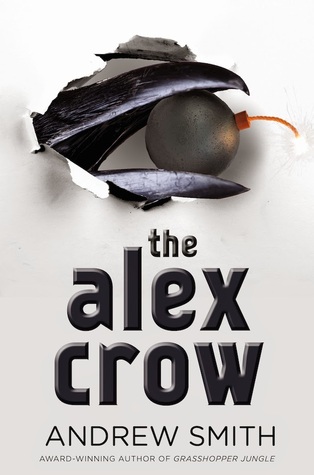
The Alex Crow by Andrew Smith

Ariel, a refugee who is the lone survivor of a massacre in his village who now finds himself living in Sunday, West Virginia.  Journal entries taken from the journal of the navigator of an Arctic expedition (appropriately name the Alex Crow expedition) over 125 years ago.  The melting man, a schizophrenic bomber out to get the Beaver King.  Then there’s the reincarnated, bionic, and suicidally depressed crow.  The Alex Crow weaves together multiple narratives to bring you a story of survival, brotherly love, morally questionable science, and the Dumpling Man.


Though not a completely negative trait of this story, The Alex Crow is different from Smith’s previous books.  Different is not bad, but when you go into a book expecting one thing and getting another you can be caught off guard.  This book, while still holding many of the same excellent qualities of Smith’s other books—its insightfulness, simultaneously serious yet ridiculous aspects, and overall good writing—some aspects of the stories almost felt lacking.  Yes, a schizophrenic bomber, a failed Arctic expedition, a refugee, and some morally questionable science can make for an interesting read.  These stories also don’t take place within the same time, the same place, or even around the same person.  Taken by itself, that can be an exciting quality in a book but in the case of The Alex Crow the content fell a bit flat.

There are some narrative bits that deviate from this but, for the most part, The Alex Crow is told from three main perspectives.  There is the main one, following Ariel, and two other secondary stories: one following the navigator of the late 19th century Alex Crow Arctic expedition via journal entries and the other following a schizophrenic bomber.  While the connections made from the secondary stories to the first are fun, overall they didn’t add much other than length.  Does a cool ending or tie-in validate storylines that needlessly break up an interesting main story?  My answer is no. 

First let’s look at Ariel’s story.  Now here is a good story.  Here’s a kid who, by a couple strokes of luck, manages to survive the complete and utter massacre of his village—which is located somewhere on the other side of the plan and, given the time the story takes place, the US military involvement, and the names of the people who live in the area, I think it’s safe to assume it’s somewhere in the Middle East.  Then he spends time traveling/surviving with some US troops.  Then with varying groups of refugees.  Then back with the military.  Then is adopted by an American family.  Then is thrown into a summer camp for kids who have become addicted to technology.  Next, throw in the fact that his father works for a company where he is one of the leads in working on de-extinction and other mad-scientist level experiments, as well as some questionably real urban myths.  There’s a lot there for a good story.  His story provides current day narrative, as well as retelling of events from the massacre until they finally catch up with the events of the book.  There’s an awesome base for an amazing story right there, then mix in Smith’s flare for the bizarre and you have yourself an outstanding adventure.

It’s when the other two stories are thrown in that the book started to seem a bit odd, and not in the good way.  The expedition and schizo-bomber were seemingly added for no other reason than cool tie-ins, lone elements that would not detrimentally impact the main story at all were they missing.  As I got through the book I wondered what importance they might hold but, by the end, the expedition story was made redundant almost instantly, and the schizo-bomber wouldn’t have changed anything with his lack of presence. 

The first of those, the Alex Crow expedition, by itself could have made for an interesting read on an online forum, maybe even in a book that had a more direct and active relation to the pseudo-historical events described in the journal entries.  It could have also made a good horror/thriller novel, depending on the route taken with the information it held.  As a complete story, I may have even liked it more than Alex Crow.  The story, as it’s delivered to the reader, is so broken up that any impact it may have had on the reader is taken away.  The information it held played into the story slightly, but only to the point of a few “oh, that’s neat” and “huh, well what do you know” moments. 

The second, that of the schizophrenic bomber, had the same impact as the expedition arc.  By itself it also would have made for an interesting read on an online forum (though most likely a different forum than the expedition would be found on).  All in all, even though I wanted to know just what relevancy his character had to the story, and even though I enjoyed how these sections were written, I couldn’t help but groan when I saw I’d arrived at one of his moments.  The tie in was neat but didn’t have any impact and, again, held no overall relevancy to the story as a whole. 

I want to be clear on this point.  I enjoyed the expedition story—I even wish there was more of it because of my level of enjoyment—and liked the schizophrenia story.  They were fun to read.  At the same time it seemed like they were ideas for stand-alone stories that didn’t come to fruition so, instead, they were tacked onto Alex Crow because someone in the publishing process liked them enough.  With the back and forth between the various storylines of varying qualities, these mostly unnecessary storylines distracted too much from what mattered and diminished much of the excitement that might otherwise have come about.  Throughout the story, knowing Smith’s writing, I was positive that they’d all tie together in some way.  I just didn’t care.

Even though aspects of the story didn’t appeal to me (though Ariel’s story did to a large degree), I still enjoyed the mechanics of it.  The way multiple semi-unrelated stories were told together with odd interweavings was fun.  Taken in parts the book was incredibly exciting, interesting, fun, and thoughtful.  Yet, when all of those parts were put together it somehow lost something.  At the end of the day, the biggest problem is that there were some well written and interesting but overall pointless side stories.  Nevertheless, although the story is a bit different than I expected, The Alex Crow is a well-written book that could very easily appeal to fans of good writing as well as fans of good stories.  Ever present in Smith’s writing is his easily identifiable narrative voice.  For anyone who hasn’t read any of Smith’s works, which I recommend you do, it’s as though the narrator of the story is aware that they’re telling a story but they’re not really talking to anyone (except for the times that they clearly are).  The diction and syntax just happen to work that way and it makes the experience of reading that much more pleasant.  If nothing else, the physical act of reading the words on the page will be relaxing.

If you’ve read and enjoyed Smith’s previous stories by no means should you skip this book.  Smith maintains his positions as one of the top YA authors, appropriately making this perfect for any fans of YA fiction out there.  Likewise, I’d recommend this book for any historical or science fiction fans because—even though they’re a bit hidden—the sci-fi and pseudo-historical elements in this book should keep your interest.

Rating: 3.5/5

Sunday, June 28, 2015

Lexicon by Max Barry

In the secret world of the poets—humans that, through the power of language, have gained the ability of human compulsion—Max Berry delivers us Emily Ruff and Wil Jamieson.  The first narrative arc belongs to that of Emily, a sixteen year old girl making a living by hustling card games on the streets of San Francisco, able to analyze her marks to a frightening degree. Frightening enough that the poets have sought her out.  As her life quickly takes an unexpected turn, she finds herself at a private, and secret, school where she will learn all she needs in order to sway anyone to her will.  Every human has a unique ‘code,’ a sequence of four special words that allow the speaker access to their thoughts and will.  Through studying an individual, the poets are able to categorize them, determining just what specific order of words will unlock their mind.  This new world is a world of specific rules, rules that must never be broken and Emily, Emily has no small problems with following rules.  The second narrative arc follows that of Wil, a young man who finds himself thrown into a supposed poet war.  With no clue as to why he’s been dragged into this fight, the only information the reader is given is that Wil’s memory has been compromised and that something horrible happened in a place called Broken Hill, Australia.

In Max Berry’s Lexicon we are in a world, very much like our own, but within it lies a secret organization of poets, each member given the name of a famous poet to act as their code name.  “The pen is mightier than the sword.”  The adage about the superiority of language, of words, over any amount of force is expanded upon within this book.  More than mere wordsmiths, these poets have such vast knowledge over the human psyche that, with the right words, they can compel any human being to do whatever they wish them to do.

The two key phrases found throughout the book are “’Tower of Babel’ event” and “barewords,” with the latter causing the former.  Normal coercion requires that a poet analyze an individual’s personality to determine what precise sequence of four words it will take to be able to control the individual.  Being aware of this ability, many poets have built up defenses to protect themselves from other poets.  With the use of these barewords, none of that matters.  Merely looking at the word makes an individual susceptible to coercion and worse.  The best way to think of an uncontained bareword, in this case inscribed on a small object, is as if a nuclear reactor had melted down.  And with the complete release of a bareword is a Tower of Babel event, resulting in the destruction of all language.  Honestly, while it seems daunting, I would have liked if the book had gone into more detail here.

Emily has been living on the streets, using card games and her innate ability to analyze and understand people to make enough money to get by.  It was a character introduction that was neither good nor bad, but it was well constructed.  Once we get to her developing her abilities to become a poet and her use of those abilities, whether likeable or not, I appreciated Emily’s comparative difference to those that surrounded her, as well as other young protagonists in their own stories.  Since others around her succeeded where she did not, using abilities and other natural talents that she didn’t possess, she used the skills that she did possess to their fullest in order to fight against that imbalance.  That use of skills was excellent to see in place of the luck of many other main characters, characters who only manage to succeed because of coincidental events rather than their own planning and abilities.

Wil finds himself at the center of a war between poets, only knowing that something horrible has happened at Broken Hill.  Fresh off a plane he’s both kidnapped and protected by two strange men, who drag him towards a place he has no recollection of.  I can’t say whether Wil’s character seemed too whiny, or if it was the right amount of complaint coming from someone in his particular situation.  While I’d like to, I can’t talk too much about the progression of his character or I’d risk spoiling something for you.  It is through Wil’s character that many of the mysteries of the story are revealed, so in that I would call him more of a device than an actual character.  So while the writing behind him was strong, it was hard to shake the impression of him functioning as a tool rather than a person.

The story itself, the way that the narrative jumped back and forth between Emily and Wil, was highly enjoyable.  On one hand you have Emily who is able to learn about the world of the poets as she tries to find her place.  On the other you have Wil who is dragged in head first with little to no ability to act on his own.  The two stories both involve the unifying thread of the poets, yet while Emily finds herself in relative peace, Wil’s perspective of their world is pure chaos.  The world that Emily couldn’t see, yet Wil could, was enjoyable as a reader.  However, as mentioned above, Wil functioned more as device than person.  Had the two stories been separated, Emily’s story would have succeeded and made sense while Wil’s would not have.  And yes, that’s an unfair point to examine as this story is not two individual stories, but one made from intertwined arcs. 

This was a story where I caught myself off-guard by my own enjoyment.  As characters, neither Emily nor Wil excited me in any special way, but the story itself is what pulled me along.  The world that existed within the pages of Lexicon and the laws that governed it was one that I could definitely have no problem reading more into.  While the story focused primarily on Emily and Wil, there were also times went it delved more deeply into the world of the poets, specifically through the eyes of Yeats.  While I can’t give too much away, seeing things through his eyes would make for an exceptional story and, if you’re anything like me, you’ll definitely appreciate what Barry made in Yeats.

The story itself is both exciting and fresh, detached from the typical physical action packed story that make up many fictitious thrillers.  It’s a story where the good and bad guys alike rely on their words as much as their physical actions in order to drive the story.  A story where a word has the power to change the world.  Where words are the most powerful weapon.

In previous reviews I’ve mentioned events that I haven’t wanted to spoil.  In the case of Max Berry’s “Lexicon,” the ending is something else entirely.  Now, before the end there will definitely be readers who are able to predict what the ending holds.  However, whether you see the ending coming or not, you’ll definitely get a kick out of it.  If you fall into the first group or the second, the writing and storytelling that Berry utilizes to make the ending work as beautifully as it does is something to be admired.  That being said, when looking at the story as a whole, there were parts of Emily and Wil’s adventure that could have gone differently, even better, had Barry not been trying to arrive at the ending he did.  So it’s a hard thought on whether or not the end justifies the means.  Although, the way that Emily and Wil’s arcs are woven together is just breath-taking.

Lexicon is one of a growing number of conspiracy thrillers, so I would accordingly recommend this to any reader who takes pleasure in thrillers, mystery, or conspiracy.  That isn’t to leave out all those who enjoy science fiction and paranormal.  If you’re an avid reader, then this book is a must for your reading list!

Rating 4/5